ByJohn A
Same-Day Crowns and 3D Scanning: How Digital Technology Is Changing a Visit to a Dental Practice in Northampton and Beyond
Quick answer: Same-day crowns use chairside CAD/CAM technology: the tooth is scanned digitally, the crown is designed on a computer and milled in the practice, then fitted in a single visit. Alongside 3D imaging for implant planning, this digital workflow means fewer appointments, no temporary crowns and no messy impression trays for many patients.
For decades, getting a crown meant two trips to the dentist, a mouthful of impression putty, and a couple of weeks with a temporary crown that you hoped wouldn’t come loose at dinner. For many patients that is no longer the case.
Digital tools that once belonged in laboratories now sit in the surgery itself. They are quietly changing how long treatment takes, how it feels, and how much of your diary it eats up. Here is how same-day crowns and 3D scanning work, what the evidence says, and where the limits are.
How a Crown Used to Be Made
To see why same-day crowns matter, it helps to know what they replace.
Two visits and a temporary
A traditional crown usually takes two visits. At the first, the tooth is prepared, an impression is taken, and a temporary crown is fitted. The impression goes to an external laboratory, and you return once the permanent crown is ready, as a review of chairside restorations describes.
The impression tray
Conventional impressions involve biting into a tray of soft material and holding still while it sets. For people with a strong gag reflex or a dislike of the taste, it is often the part of treatment they dread most.
How Same-Day Crowns Work
Same-day crowns compress that whole process into a single appointment.
What CEREC stands for
The best-known system is CEREC, which stands for Chairside Economical Restoration of Esthetic Ceramics. According to its manufacturer, Dentsply Sirona, the technology has been in use for more than 35 years.
Scan, design, mill, fit
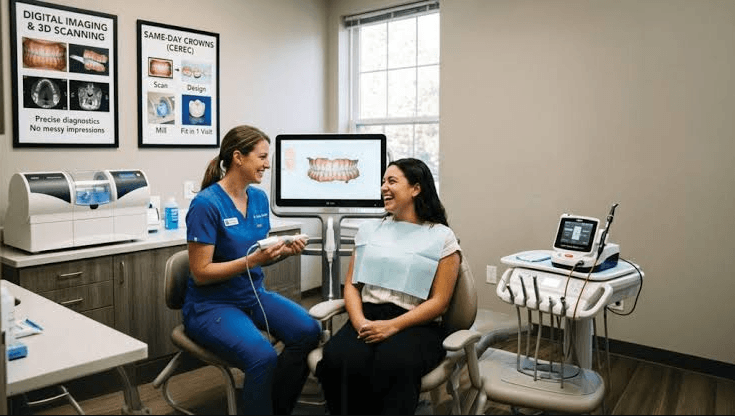
The process follows four steps. A handheld 3D scanner captures the prepared tooth. Software then designs the crown on screen, and a milling unit in the practice shapes it from a solid block of ceramic. The dentist then bonds it into place, all while you wait.
No temporary crown
Because the final crown is made on the day, Dentsply Sirona notes that same-day crowns remove the need for temporaries. That means no second injection, no second appointment and no fragile stopgap in between.
Digital Impressions: The End of the Putty Tray?
The scanner behind same-day crowns is also replacing traditional impressions more widely.
What patients prefer
A systematic review summarised by the Dental Elf found that patients preferred intraoral scanning to conventional impressions, with less discomfort, nausea, unpleasant taste and breathing difficulty. It found no clear difference for anxiety or pain.
Accuracy and time
A 2022 umbrella review found that most studies rated intraoral scanning as precise and accurate as the conventional method, and better for patient preference and time. It also noted that conventional impressions are still recommended for larger, more extensive work, so digital scanning is not yet the answer to everything.
3D Imaging and Implant Planning
The other big shift is in how dentists see what’s beneath the gum.
What cone beam CT adds
Cone beam CT (CBCT) produces a three-dimensional image of the jaw, letting a dentist measure bone and locate nerves and sinuses before placing an implant. The American College of Prosthodontists notes in its imaging position statement that CBCT is preferable to conventional medical CT because of its significantly lower radiation dose.
Not a routine scan
3D imaging still uses X-rays, so it must be justified. Guidance in the field recommends cross-sectional imaging when clinical examination and conventional X-rays have not shown the relevant anatomy clearly enough. A co-author of the UK’s dental radiography selection criteria has pointed out, in an interview with The Dentist, that European guidance accepts conventional radiography may be enough for some implant cases. A good practice will explain why a scan is needed for you.
What This Means for Patients
Same-day crowns and 3D imaging change the experience of treatment in very practical ways.
Fewer appointments
One visit instead of two means less time off work, one less journey and one less round of anaesthetic. For busy parents, shift workers and people who travel for appointments, that is often the biggest benefit.
Seeing your own treatment
Digital scans and 3D images appear on a screen in the surgery. Many patients find it easier to understand what’s happening, and to ask better questions, when they can see their own tooth or jaw rather than relying on a verbal description.
A local example
Some independent practices now have this equipment in-house. At Cliftonville Dental, the dental Northampton I co-own, we offer CEREC same-day crowns and use CT scanning when planning dental implants, and we publish our CT scan and crown prices on our fees page. If digital treatment matters to you, check a practice’s website or ask at reception which systems it uses.
Where Same-Day Crowns Have Limits
Technology doesn’t suit every case, and it’s worth being clear about that.
Not every tooth or material
Same-day crowns are milled from a single block of material in the practice. Complex cases, some bridges and work that needs a specialist laboratory may still go down the traditional route. Your dentist should explain which approach suits your tooth.
The dentist still matters most
A scanner and a milling unit are tools. The quality of the preparation, the design and the fit still depend on the skill and judgement of the person using them.
The Bigger Picture
Digital dentistry is part of a wider shift in healthcare, where data and software replace physical steps. Same-day crowns and 3D scanning show what that looks like at its best: less waiting, fewer visits and patients who can see and understand their own treatment, without losing the human expertise at the centre of it.
Frequently Asked Questions
Are same-day crowns as good as traditional crowns?
They can be, for suitable cases. Studies of digital workflows report accuracy comparable to conventional methods for many restorations, but your dentist will advise whether this approach suits your particular tooth.
How long does a CEREC appointment take?
It is longer than a single standard appointment because the crown is designed and milled while you wait, but it replaces two separate visits. Ask your practice how long to allow.
Is a dental CT scan safe?
It uses X-rays, so it should only be taken when there is a clear clinical reason. Cone beam CT uses a significantly lower dose than conventional medical CT.
Do digital scans replace all impressions?
Not yet. Digital scanning is preferred by many patients and is accurate for many treatments, but conventional impressions are still used for some larger or more complex work.