
ByJohn A
How to Judge Bedroom Drawers Beyond Their Finish
A chest of drawers may appear straightforward: a timber box, a set of runners and a handful of handles. In daily life, however, its quality is revealed by small actions repeated hundreds of times. Drawers must slide cleanly, the frame should stay steady and the top needs to tolerate the occasional misplaced water glass or jewellery dish. Appearance matters because the unit occupies a prominent position in the bedroom, but colour and grain alone tell you little about how it will perform. Before choosing a traditional oak look or a contemporary painted finish, examine what the furniture is made from, how its drawers work and how much storage it provides for real clothes.
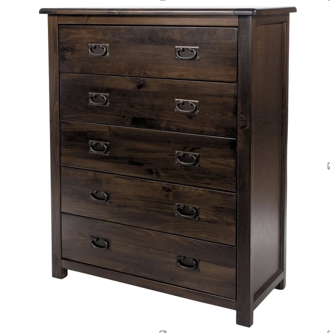
PRODUCT PHOTO | A tall five-drawer chest is one way to make use of bedroom wall height.
Read the Material Description Carefully
The terms solid oak, oak veneer and oak effect are not interchangeable. Solid oak uses timber throughout the specified components and can display natural variation in grain and colour. Veneer applies a thin layer of real wood over another substrate, offering a timber surface with a different internal construction. Oak-effect finishes imitate the appearance of grain, often on manufactured boards. Each can serve a purpose at a different price or weight, but the product description should make clear which materials are used in the top, sides, drawer fronts and internal structure.
When comparing an oak chest of drawers, check the details on the specific item rather than assuming every chest in a broader collection uses solid oak. Also consider where the unit will sit. Timber responds to moisture and changes in room conditions, so place it sensibly away from persistent damp and strong heat. Finished surfaces need the care advised by the manufacturer, regardless of whether the visible grain is solid timber or veneer.
Look Beyond the Fronts to the Drawer Construction
Pull a drawer open, if viewing furniture in person, and notice how evenly it moves. A well-aligned drawer should run without scraping or feeling loose. Different runner systems offer different characteristics: metal slides may provide smoother travel or greater extension, while traditional wooden runners can be appropriate for certain designs but may need different care. There is no single mechanism that guarantees quality, so look at its load rating, travel and installation as well as its name.
A chest should also feel steady when it is opened in normal use. Inspect the frame for twisting and check whether adjacent drawer fronts remain aligned. If a furniture listing gives a maximum load for each drawer, treat that limit as part of the buying decision, especially if the unit will store heavy textiles. Good design combines usable capacity with mechanisms suited to that load.
Check the drawer bottoms and how securely they sit in the sides. Thin bases may be adequate for light accessories but less suitable for dense stacks of clothing if not supported properly. Inspect the joints where drawer fronts and sides meet. Strong, accurately assembled joints matter whether they are dovetailed, dowelled or made using other sound methods. Handles should feel firmly fixed, with enough clearance for fingers without catching on nearby furniture.
Work Out Capacity Using What You Own
PRODUCT PHOTOS | Wide and narrow drawers have different footprints; check dimensions for each specific item.
A tall chest with five shallow drawers may store underwear and accessories neatly but struggle with bulky jumpers or spare bed linen. A wider unit with fewer deep drawers may be more useful for a different wardrobe. Before buying, measure stacks of folded clothes and compare them with internal, not just external, drawer dimensions. Product listings sometimes emphasise overall measurements, so look for drawer size details where available or ask before ordering.
Think about height as well as capacity. A chest with drawers reaching above shoulder level may be inconvenient for frequent use, particularly for a shorter person. Lower drawers should be easy to access without repeated awkward stretching, and the top surface should be at a practical height for the items you intend to place there. Storage works best when the objects used daily sit in the easiest compartments.
Check the Fit, Stability and Delivery Route
Measure the proposed wall space, allowing for skirting, plugs, wardrobe doors and the distance drawers need to open. A deep chest can block circulation in a narrow bedroom even when its width seems reasonable. Mark its outline on the floor and simulate using the drawers. Consider the delivery route too: stair turns, tight hallways and door widths may be more limiting than the bedroom dimensions. Find out whether the unit arrives assembled and whether two people will be needed to position it safely.
Follow the manufacturer’s wall-anchoring instructions, particularly for taller chests and in homes with children. Open drawers change the distribution of weight, and suitable anti-tip fittings are an important precaution. Keep heavier items lower down and avoid overloading extended drawers. Check how the cabinet sits on the actual floor; a slight unevenness can affect drawer alignment and overall stability.
Choose a Finish You Will Be Happy to Maintain
Natural oak tones can sit comfortably alongside cream walls, soft greens, muted blues and textured fabrics. Painted finishes may suit a lighter or more contemporary scheme, while darker stains can make the furniture a stronger focal point. Consider the grain, handle design and shape together rather than matching timber colours too precisely. A chest can complement the bed frame without looking as if both came from the same matching set.
Dust with a suitable soft cloth and deal with spills promptly. Avoid abrasive cleaners and follow any guidance about polish, oil or wax, since not every wood finish should be treated in the same way. Use mats beneath plant pots, cosmetics and drinks. A little preventive care protects the surface far more effectively than trying to repair avoidable marks after they appear.
Buy for the Drawers You Will Open Every Day
A good chest balances dependable construction, useful dimensions and a finish that suits the room. Material labels are a starting point, not a substitute for inspecting joints, runners and internal capacity. Measure carefully, consider safety and choose an arrangement that makes daily dressing simpler. The best piece earns its place through years of ordinary, easy use.
